Jólakötturinn
Description
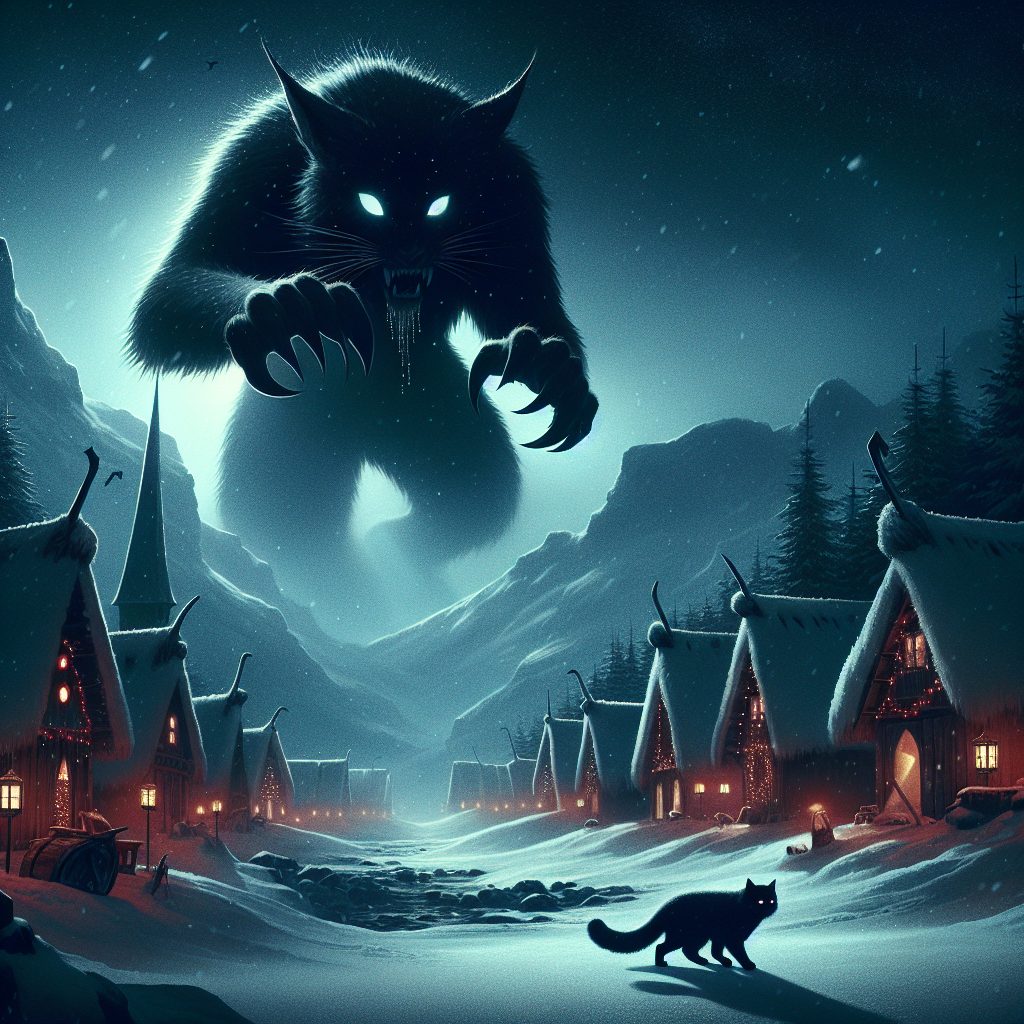
Enormous black cat belonging to Grýla that devours anyone not wearing new clothes before Christmas Eve. Prowls snowy villages peering through windows to find poorly-dressed victims
Origin & Background
The first definite mention of Jólakötturinn was made in 1862 in Jón Árnason's collection of folklore tales titled 'Íslenzkar þjóðsögur og æfintýri'. In this book, it is described as a malicious monster that eats those who do not receive new clothes for Christmas. Jón did not specify the source of this story. Subsequently, two theories have been proposed regarding the origin of Jólakötturinn. The first theory, presented by folklorist Árni Björnsson, points out the expression 'to dress the cat' in Jón's commentary, claiming that this expression contributed to the creation of Jólakötturinn. The second theory, proposed by archaeologist Guðmundur Ólafsson, connects Jólakötturinn to various entities accompanying Saint Nicholas in other European traditions. Guðmundur emphasized that historically there is a lack of material on folklore, mentioning that the scarcity of documents about Jólakötturinn is not of great significance. Traditionally, Jólakötturinn was used as a threat to encourage farm workers to process the wool collected in the autumn before Christmas. Those who participated in this task received new clothes, while those who did not received nothing and became prey for Jólakötturinn.
The Legend
Jólakötturinn is a mythical cat from Icelandic Christmas folklore, said to hide in the snow-covered countryside during the Christmas season and eat those who do not receive new clothes before Christmas Eve. In other versions of the story, Jólakötturinn is said to eat the food of those who do not receive new clothes. Jólakötturinn is closely associated with other figures in Icelandic folklore and is considered a pet of the giantess Grýla and her sons, the Yule Lads.
In Popular Culture
Jólakötturinn became a part of classic Icelandic Christmas folklore with the publication of the poetry collection 'Jólin koma' by Jóhannes úr Kötlum in 1932. One poem in this collection, titled 'Jólakötturinn', focuses on the monster that eats those who bear its name, and it later became a common element of Icelandic Christmas festivities and decorations. In 2008, the English online newspaper 'The Reykjavík Grapevine' published an article about Jólakötturinn, contributing to its international recognition. In 2018, a 5-meter tall steel sculpture of Jólakötturinn was installed as a Christmas decoration in the central square of Reykjavík. In December 2023, a film about Jólakötturinn titled 'Þið kannist við...' was released in Iceland.
This article is based on the Wikipedia article "Yule cat" (CC BY-SA 4.0) · Wikipedia
Abilities
- Gigantification
- Predation