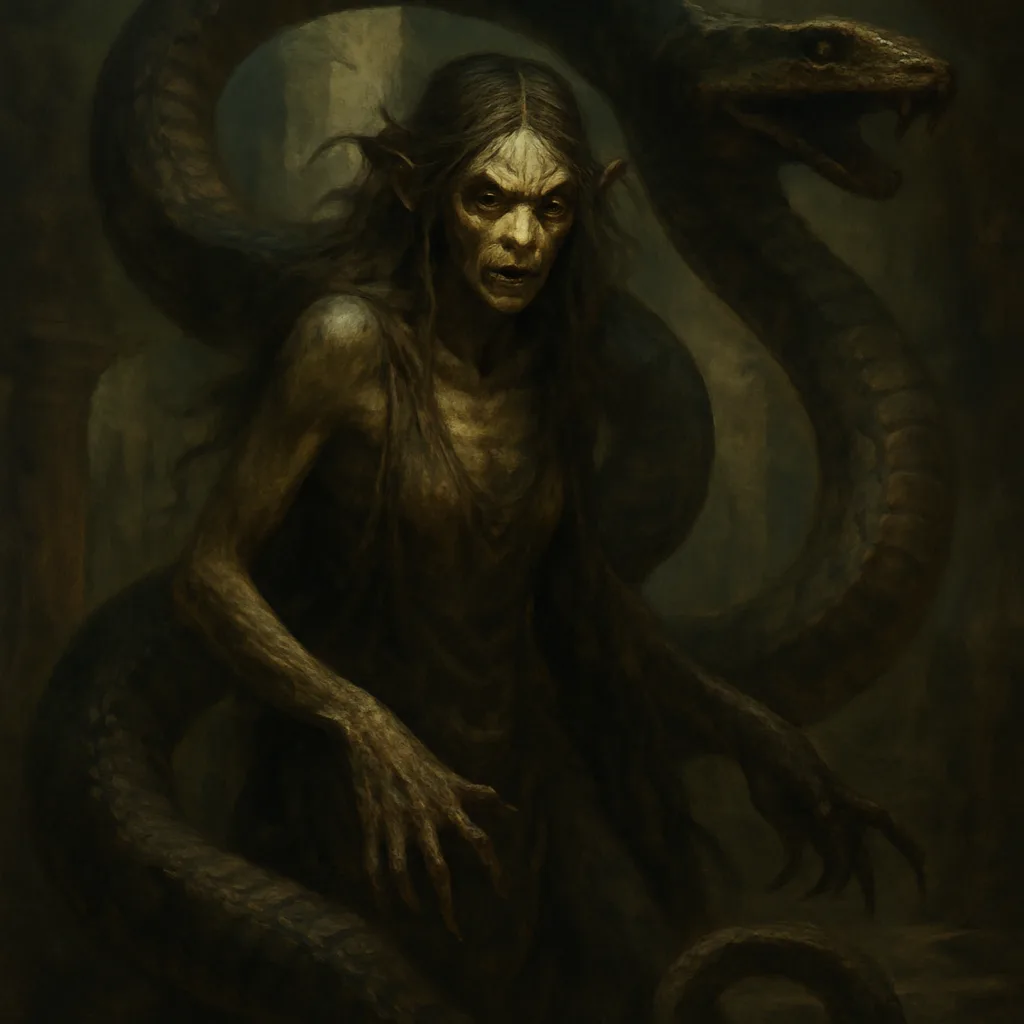
Abyzou
Description
A demon from the folklore of Egypt. In the myth and folklore of the Near East and Europe, Abyzou is the name of a female demon.
Origin & Background
A.A. Barb connected female demons similar to Abyzou with the story of Abzu, the primordial sea in ancient Mesopotamian religion. He argued that the name 'Abyzou' appears to be a variation of the Greek word ἄβυσσος ábyssos meaning 'abyss'. The primordial sea was originally androgynous or asexual, later divided into the male Abzu (freshwater) and the female Tiamat (saltwater). Female demons are often considered to have originated from the primordial sea.
The Legend
Abyzou is known as a female demon in Near Eastern and European mythology and folklore, blamed for infant mortality and stillbirths. She is depicted as a jealous being, attempting to steal the children of other women because she is infertile. In ancient Greek literature, she appears under the name 'Obizuth', with the most complete literary description found in 'The Testament of Solomon'.
Variants
Abyzou is referred to by various names and frequently appears in magical incantations in languages such as Greek, Hebrew, and Romanian. Her Babylonian name, Gyllou or Gylou, often appears in magical texts, and in ancient Greek stories, there is a scene where she reveals 'the name of the twelve and a half'.
In Popular Culture
In the 2012 horror film 'The Possession', Abyzou appears as the name of the dybbuk that torments one of the main characters, Emily 'Em' Brenek. In the Fox fantasy series 'Sleepy Hollow', in the episode 'The Sisters Mills', Abyzou appears as a main antagonist, where she is depicted as the origin of the tooth fairy myth. Abyzou also appears as a main antagonist in the 2023 horror film 'The Offering'.
This article is based on the Wikipedia article "Abyzou" (CC BY-SA 4.0) · Wikipedia
Abilities
- Magic
Weaknesses
- Certain rituals
Sources
- Wikipedia (Female legendary creatures)
Genres
Story Hooks
- A demon from the folklore of Egypt. In the myth and folklore of the Near E