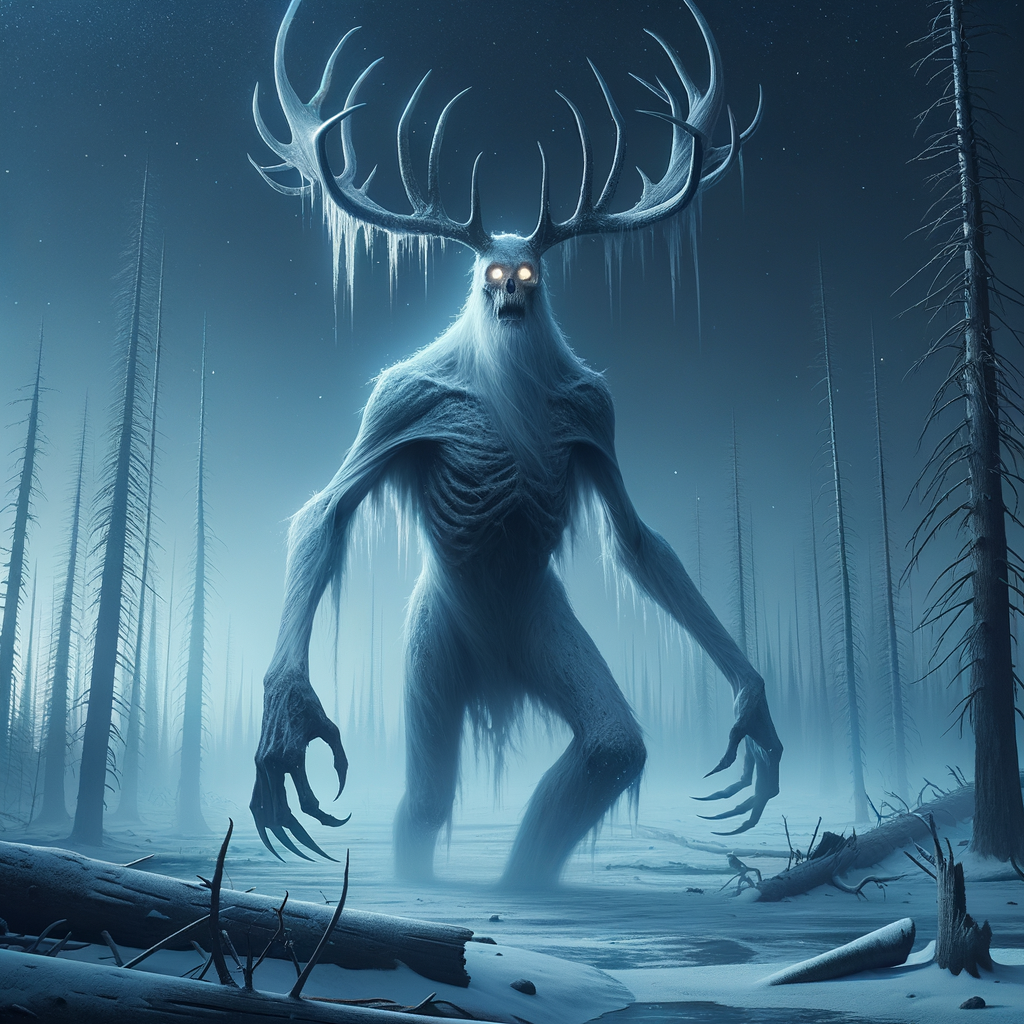
Wendigo
Description
Algonquian spirit of insatiable hunger and cannibalism, grows with each meal
Origin & Background
Wendigo is a mythological being or evil spirit originating from Algonquin folklore. The modern English word 'wendigo' is a loanword with multiple origins, partially borrowed from Cree (wīhtikōw) and Ojibwe (wiindigoo). This word appears to have been used in English since 1714 and became widely known in English through Algernon Blackwood's 1910 novel 'The Wendigo.'
The Legend
Wendigo is often depicted as an evil spirit and is portrayed as a being with human-like characteristics. It is said that this being can possess humans, instilling in its victims an insatiable hunger and a desire to consume other humans. Wendigo is described as a gigantic humanoid with an icy heart, and its presence is said to be accompanied by a foul odor or a sudden chill. In modern psychiatry, there is a disorder known as 'Wendigo psychosis,' characterized by an intense craving for human flesh and a fear of cannibalism.
Variants
A similar being to Wendigo is 'wechuge,' which appears in the legends of the Athabaskan people of the Northwest Pacific Coast. Wechuge is described as cannibalistic and possessing insights from ancestors.
In Popular Culture
Wendigo appears in various forms in modern popular culture. Algernon Blackwood's novel 'The Wendigo' has influenced many horror stories, and it appears as an embodiment of evil in works such as Stephen King's 'Pet Sematary.' In Marvel Comics, a character inspired by Wendigo appeared in 1973, and Wendigo also appears as an enemy in video games like 'Until Dawn' and 'Fallout 76.' Additionally, contemporary authors are exploring the Wendigo legend in their works.
This article is based on the Wikipedia article "Wendigo" (CC BY-SA 4.0) · Wikipedia
Abilities
- Growth and transformation