Ajatar
Description
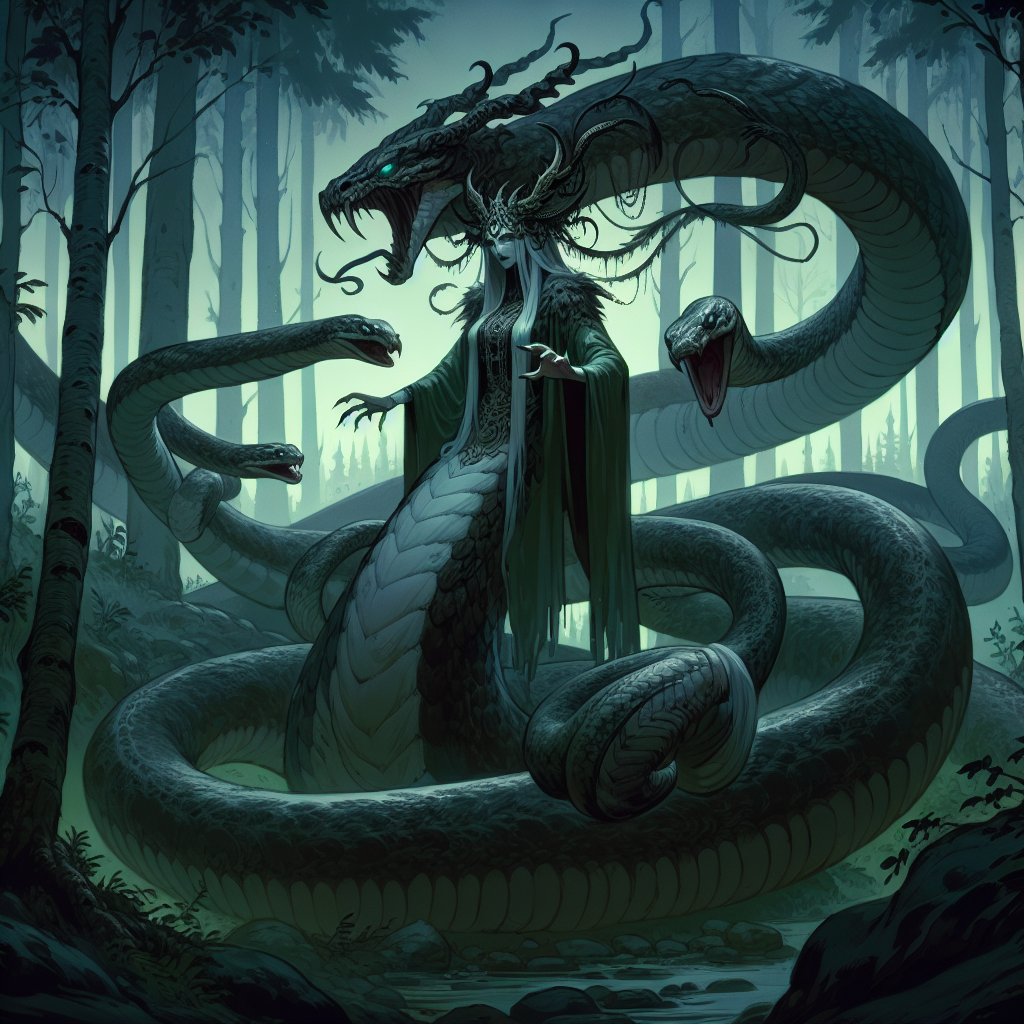
Evil female forest spirit and dragon of Finnish mythology. Suckles serpents and spreads disease. Her very presence causes anyone who looks at her to fall violently ill. Mother of the Devil in some traditions
The Legend
In Finnish folklore, Ajatar is depicted as an evil female spirit. She is described as a being with 'hair down to her heels and a chest that hangs down to her knees,' similar to Sweden's Skogsrå, Denmark's 'seawoman,' or the wildfraulein of the Eiffel. Ajatar is known for spreading disease and plague through her association with Hiisi and Lempo. She is closely associated with snakes and is often depicted in modern art as a dragon or in a half-human, snake-like form. Ajatar is referred to as an 'evil being' or 'witch,' and according to Christian Erici Lencqvist, she is described as a terrifying female forest haltija. Additionally, Eemil Nestor Setälä has shown that Ajatar may appear as Aattara in rune songs from western Finland.
In Popular Culture
Ajatar does not appear in documented Finnish folk songs but is found in fiction inspired by the Kalevala and modern fantasy interpretations. In Aleksis Kivi's play 'Kullervo,' Ajatar is portrayed as a fierce and shameless being who leads the protagonist to kill his master's family. Ajatar lives in the mountains and has Lempo and Gnomes as her servants, and her maternal grandfather is mentioned as Hiisi. Furthermore, in Brett Stuart Smith's novel 'The Eye of Disparager,' Ajatar is described as a beautiful being with a female upper body covered in green scales and a lower body made up of several snakes. Ajatar is also used as a term to refer to certain demons or evil spirits in some translations of the Finnish Bible.
This article is based on the Wikipedia article "Ajatar" (CC BY-SA 4.0) · Wikipedia
Abilities
- Plague