Nasnas
Description
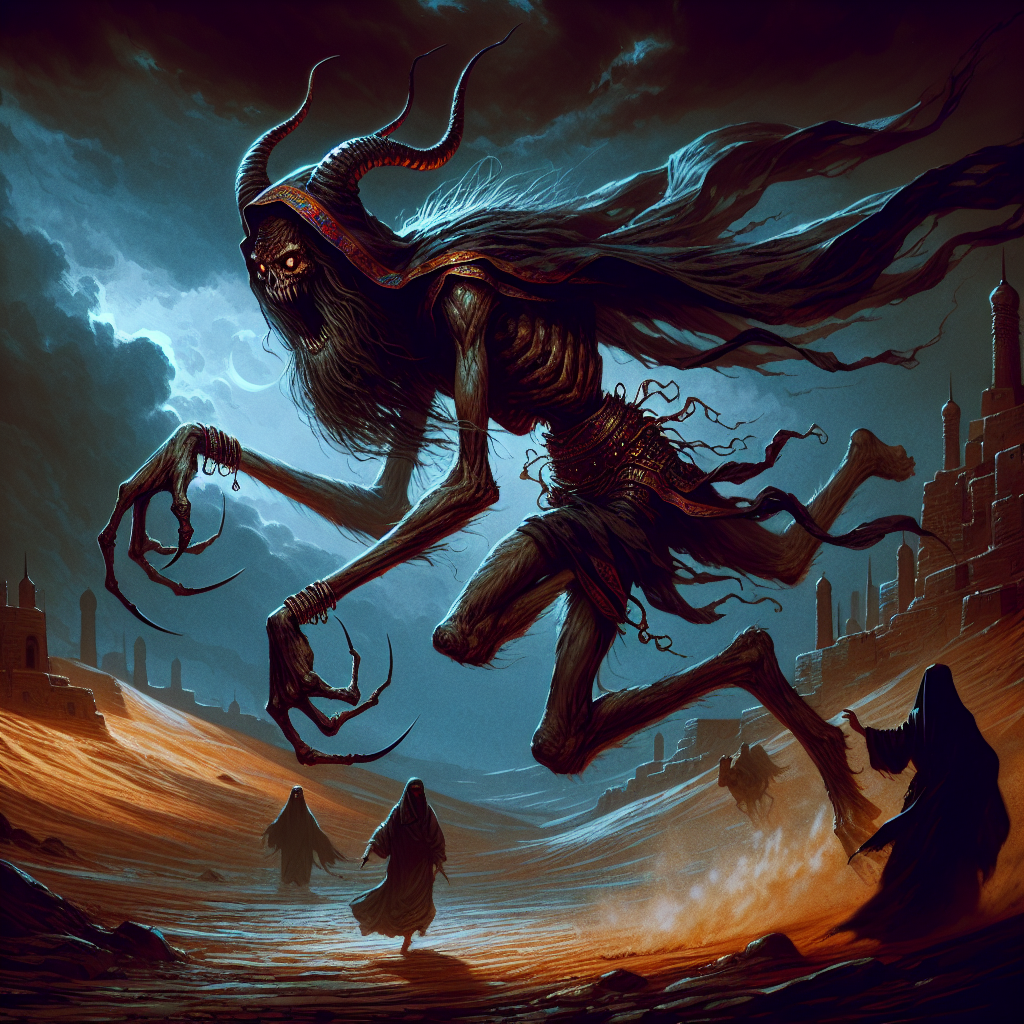
Creature with half a human body — one arm, one leg, half a face. Hops with terrifying speed through the Arabian desert killing with a single touch
The Legend
In Arab culture, the nasnas is described as a monstrous being with a single leg. Edward William Lane, the translator of 'One Thousand and One Nights' in the 19th century, described the nasnas as 'a half-human being, with half a head, half a body, one arm, and one leg, who jumps around very nimbly.' Additionally, in Somali mythology, there is a similar being called xunguruuf, which is said to be able to kill a person just by touching them. The xunguruuf is considered the offspring of a spirit called shiq and a human.
Variants
The nasnas is not found in the Quran, the holy book of Sunni Islam, but is occasionally mentioned in Shia sources. References to the nasnas are related to verse 30 of chapter 2 of the Quran, where God commands the angels to create humans as successors on Earth. As a result, it is said that angels lived in the heavens, while jinn and nasnas lived on Earth. After 70,000 years, God lifted the veil between the seven heavens and the Earth, and the angels saw that they had committed injustices. The angels complained that such destruction could not be tolerated in God's creation, and God decided to replace them. Similar stories exist in Sunni sources, but the nasnas is not mentioned, only the jinn. In Shia sources, the nasnas is often depicted as the archetype of the opposing forces of Shia, while the jinn are considered beings that obey the Imam.
In Popular Culture
The nasnas is mentioned in the story 'The Tale of the Sage and the Scholar,' where after a magician applies kohl to one of his eyes, one of the characters transforms into a nasnas. Additionally, the nasnas is referenced in Gustave Flaubert's 'The Temptation of Saint Anthony.'
This article is based on the Wikipedia article "Nasnas" (CC BY-SA 4.0) · Wikipedia