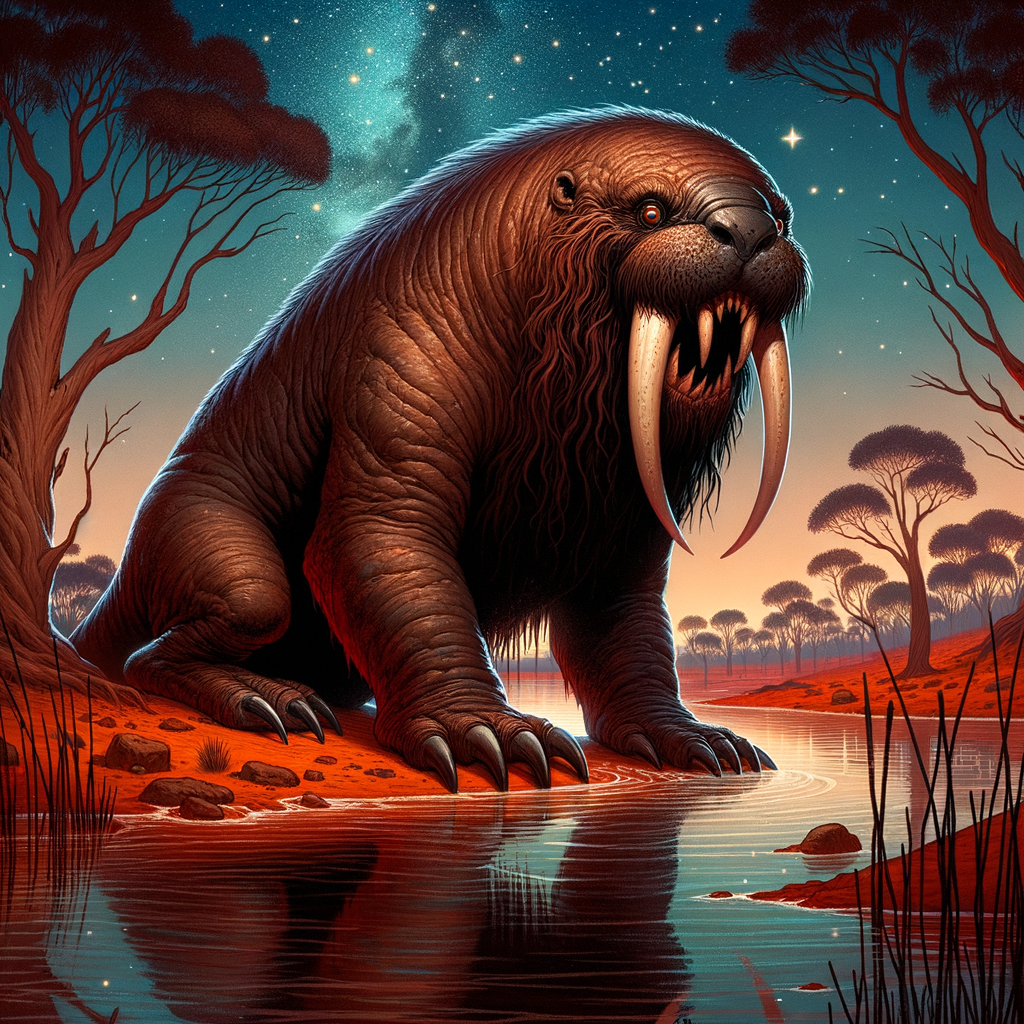
Bunyip
Description
Terrifying creature of swamps and billabongs in Aboriginal tradition
Origin & Background
The origin of the word Bunyip can be traced back to the Indigenous languages of Wemba-Wemba or Wergaia in southeastern Victoria, Australia. Today, Australian Indigenous people generally translate bunyip as a demon or evil spirit. However, these modern translations may not exactly align with the role that bunyip played in pre-contact Indigenous mythology or its origins before written records were created. Some modern sources suggest a linguistic connection between bunyip and Bunjil, the mythological 'Great Man' who created mountains, rivers, and all animals. The word bunyip first appeared in the Sydney Gazette in 1812, where James Ainsworth described it as 'a large black animal with a terrifying voice that instills fear among the Indigenous people.'
The Legend
Bunyip is a creature that appears in the Indigenous mythology of southeastern Australia, said to lurk in swamps, billabongs, creeks, riverbeds, and waterholes. Bunyip is part of traditional Indigenous beliefs and stories, and its name varies according to tribal naming conventions. Bunyip is described as an aquatic creature, with no reports of it being sighted on land. The physical characteristics of bunyip are described in various ways, generally falling into two categories. The first resembles a seal or a swimming dog, measuring 4 to 6 feet in length, with fur that is black or brown. The second is a creature with a long neck, measuring 5 to 15 feet, with a head similar to that of a horse or emu, large ears, and small teeth. Bunyip is depicted in Indigenous mythology as being able to swim quickly, howling loudly, and as a predator with a bloodlust that sometimes hunts crayfish or even humans, particularly women and children.
Variants
Bunyip is part of traditional Indigenous beliefs and stories across Australia, with different names depending on the tribe. Robert Holden noted in his 2001 publication that there are at least nine regional variations of the creature known as bunyip across Indigenous Australia.
In Popular Culture
Bunyip has appeared several times in modern popular culture. In 1863, a weekly newspaper published in Gawler, South Australia, called 'The Bunyip' described it as 'the epitome of true Australian bluster,' which is how it got its name. In 1962, Australian author Colin Thiele published a children's book titled 'Gloop The Gloomy Bunyip.' In 1972, a character named Alexander Bunyip, created by children's author Michael Salmon, first appeared in 'The Monster That Ate Canberra' and later developed into several books and TV series. In 2016, the independent film 'Red Billabong' was released, featuring a story centered around the bunyip.
This article is based on the Wikipedia article "Bunyip" (CC BY-SA 4.0) · Wikipedia
Abilities
- Unknown