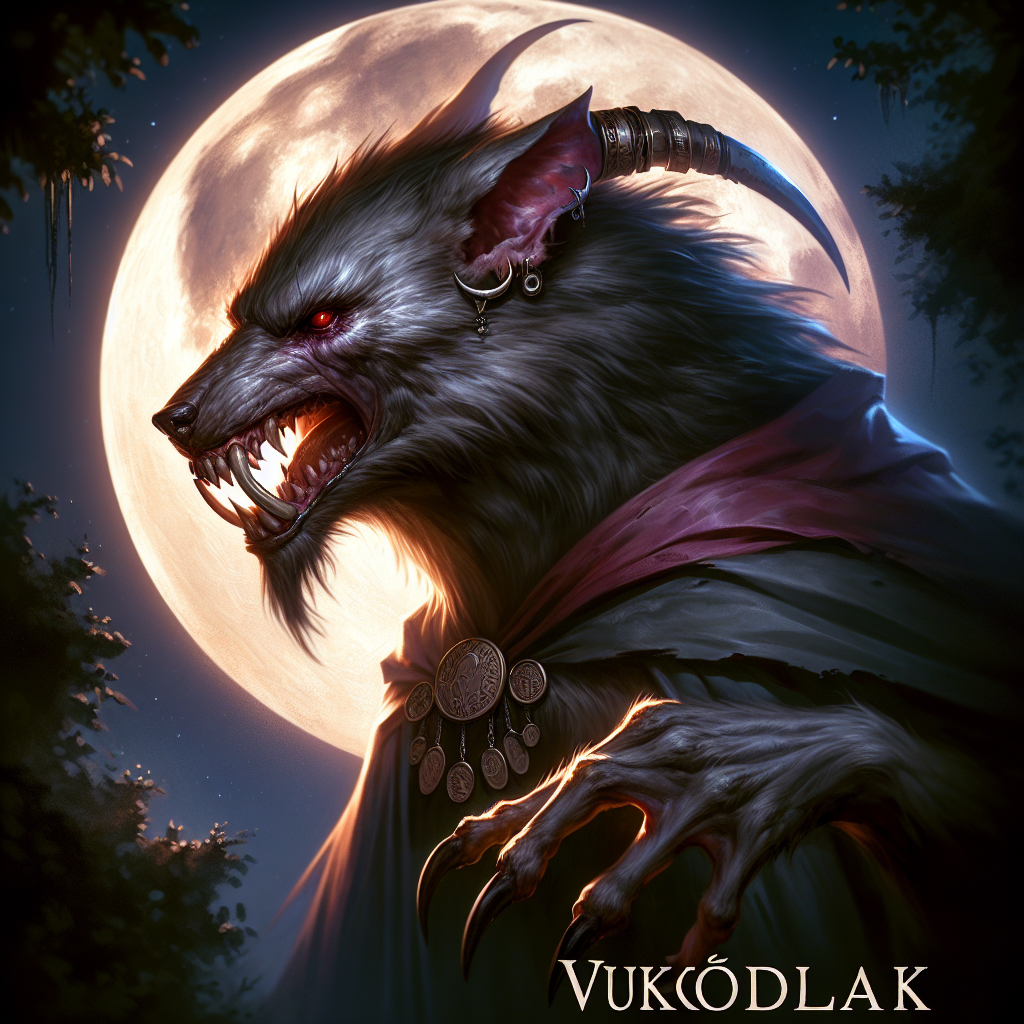
Vukodlak
Description
Werewolf-vampire hybrid that can eclipse the moon by…
Origin & Background
The motif of humans transforming into wolves exists in the folklore beliefs of all Slavic peoples, but it is best preserved among Ukrainians, Belarusians, and Eastern Poles. In Russia, the term 'volkolak' is recorded only in the southern regions, while in other areas, beings that transform into wolves are simply referred to as shapeshifters, sharing beliefs similar to those about werewolves. In Slovakian and especially Czech traditions, beliefs about werewolves are rare, and among the Sorbs, they have diminished, primarily found in Lower Lusatia. In South Slavic traditions, werewolves and vampires are often mixed, but among Slovenians, these concepts are nearly merged.
The Legend
In Slavic mythology, werewolves are described as human shapeshifters who temporarily take on the form of a wolf. Werewolves are often depicted as ordinary wolves, but some accounts mention peculiarities in their appearance or behavior that hint at their human origins. Werewolves retain human intelligence but cannot speak. According to folklore beliefs, transformation into a wolf is considered the most common form of transformation among Slavs. Transformations often occur at night or during specific seasons, and these werewolves were believed to lose control and attack livestock or even humans.
Variants
The term 'werewolf' in Slavic languages derives from the Proto-Slavic *vl̥ko-dlakъ and appears in various forms. In East Slavic, there are variations such as волкола́к, вовкула́к, ваўкала́к, while in South Slavic, forms like върколак, вуко́длак, volkodlák are preserved. In West Slavic and related languages, forms borrowed from Polish, such as wilkołak, appear.
In Popular Culture
In the 20th century, traditional beliefs about shapeshifting weakened, but in some regions, stories about wolf transformations remain popular. In modern urban demonological beliefs, perspectives on Slavic werewolves are being replaced by the werewolf images found in Western popular culture.
This article is based on the Wikipedia article "Werewolf in Slavic mythology" (CC BY-SA 4.0) · Wikipedia
Abilities
- Unknown