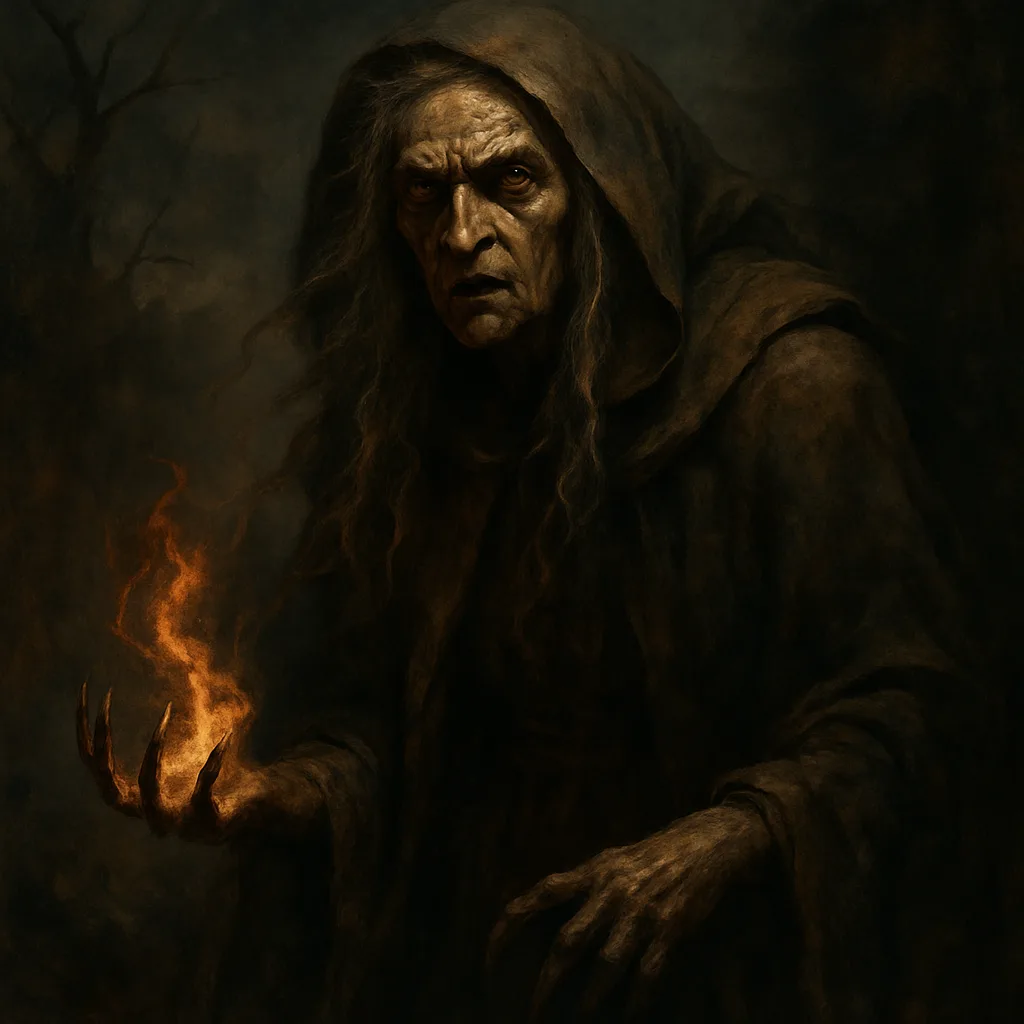
Black Annis
Description
A sorcerer from the folklore of United Kingdom. Black Annis (also known as Black Agnes or Black Anna) is a bogeywoman figure in English folklore.
Origin & Background
The earliest written record of Black Annis is found in an 18th-century title deed, which refers to a piece of land (or 'close') as 'Black Anny's Bower Close.' The first volume of 'County Folklore,' published in 1895, mentions two title deeds written on May 13 and 14, 1764. Various possibilities have been proposed regarding the origin of Black Annis. T. C. Lethbridge suggested that the legend may have originated from Celtic mythology, such as Danu or Anu, and it may also have roots in German mythology (Hel). In 1917, Donald Alexander Mackenzie proposed in his book 'Myths of Crete and Pre-Hellenic Europe' that the legend is based on an ancient European goddess, who was considered a being that devoured children. He pointed out similarities between Black Annis and Kali from Indian mythology, Muileartaich from Gaelic, Cailleach Beare, Demeter from Greece, Labartu from Mesopotamia, and Isis-Hathor and Neith from Egypt. It has also been suggested that the legend may have originated from the popular memory of sacrifices made to an ancient goddess. However, Ronald Hutton, in his book 'The Triumph of the Moon: A History of Modern Pagan Witchcraft,' opposed these theories, arguing that the legend of Black Annis is based on a real person from Leicestershire named Agnes Scott. Agnes Scott was an anchorite who lived a life of prayer in the late Middle Ages, residing in a cave in the Dane Hills and buried in the churchyard of Swinland. Hutton suggested that the memory of Scott may have been distorted into the image of Black Annis.
The Legend
Black Annis is depicted as a monstrous woman in British folklore, described as a witch or hag with a blue face. She is known to have iron claws and a preference for human flesh, particularly that of children. She roams the countryside of Leicestershire, residing in a cave in the Dane Hills, where a large oak tree stands at the entrance. Black Annis is said to come out at night to devour defenseless children and sheep, hanging their skins on trees to wear as a belt. It is said that she can reach into houses to snatch people. According to legend, she used her iron claws to dig out her cave from the side of a sandstone cliff to make her home. This legend has been used by parents to warn children that Black Annis will take them if they misbehave. Additionally, she is known to hide in the branches of oak trees, ambushing unsuspecting prey. In other traditions, it is said that when she grinds her teeth, people can hear it, giving them time to lock their doors and stay away from windows.
Variants
Black Annis has also been described in the form of a monstrous cat, and the legend led to a local ritual where a dead cat was dragged in front of her bower by a pack of hounds in early spring. This ritual, known as Easter Monday (Black Monday), extended from Annis' Bower to the mayor's house in Leicester. The bait dragged along was a dead cat soaked in aniseed. This custom disappeared by the end of the 18th century. In another tradition, Black Annis (in the form of a cat) is said to live in the cellar beneath Leicester Castle, with an underground passage leading from the cellar to the Dane Hills.
In Popular Culture
In 1837, a play titled 'Black Anna's Bower, or the Maniac of the Dane Hills' was performed at the Leicester Theatre. The plot of this play revolves around the murder of the landlady of the Blue Boar Inn, with Black Anna taking on a role similar to that of the witches in 'Macbeth.'
This article is based on the Wikipedia article "Black Annis" (CC BY-SA 4.0) · Wikipedia
Abilities
- Supernatural power
Weaknesses
- Iron
Sources
- Wikipedia (Mythological cannibals)
Genres
Story Hooks
- A sorcerer from the folklore of United Kingdom. Black Annis (also known as Black Agnes