Santa Compaña
Description
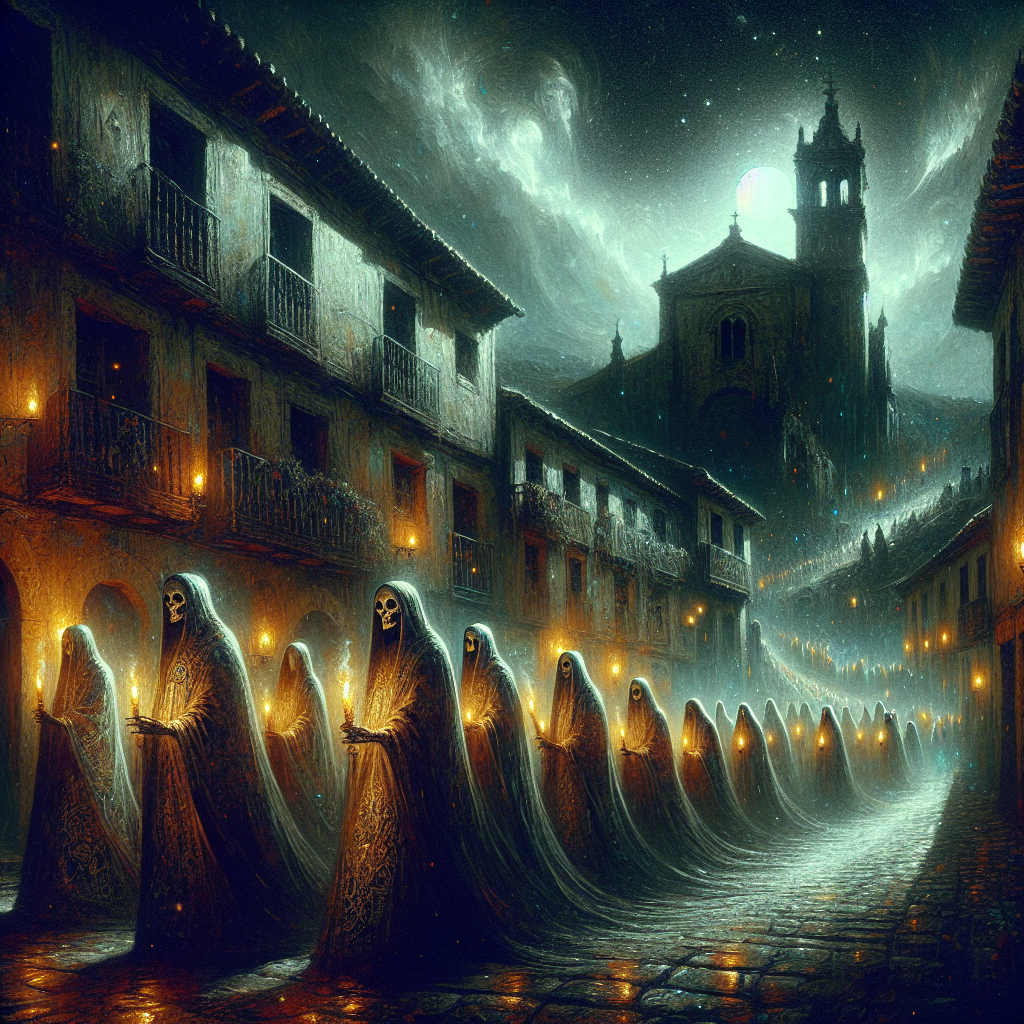
Spectral procession of the dead that walks through Galician villages at night carrying candles. Those who see it are doomed to join the march or die within the year
Origin & Background
Santa Compaña is a traditional mythological belief from the northwestern Iberian Peninsula, originating in the border regions of Galicia, Asturias, and Castile and León (El Bierzo), as well as northern Portugal. It is considered the Iberian version of the mythological motif of 'wild hunt' that is found throughout Europe.
The Legend
Santa Compaña is generally described as a procession of the dead or a procession of suffering souls, said to wander the village streets at midnight. This procession is led by a living person wearing a cloak with a white hood, holding a cross or a holy water font, followed by several dead souls carrying candles. These souls are not always visible, but their presence is said to be announced by the scent of melted wax carried by the wind as they pass. The living leader of the procession is believed to be forced by supernatural powers to wander the village and forest every night, and the next day they do not remember the event. It is believed that if this curse is not passed on to someone else, the person will eventually become ill, weak, and die.
Variants
Santa Compaña is also known by several names such as 'Estadea', 'Estantiga', 'Rolda', 'As da noite', 'Pantalla', 'Avisóns', and 'Pantaruxada', all of which are terms that indicate the presence of the dead. In Asturias, it is well known by the name 'Güestia'.
This article is based on the Wikipedia article "Santa Compaña" (CC BY-SA 4.0) · Wikipedia